
 Image 1 of 3
 Image 2 of 3
 Image 3 of 3
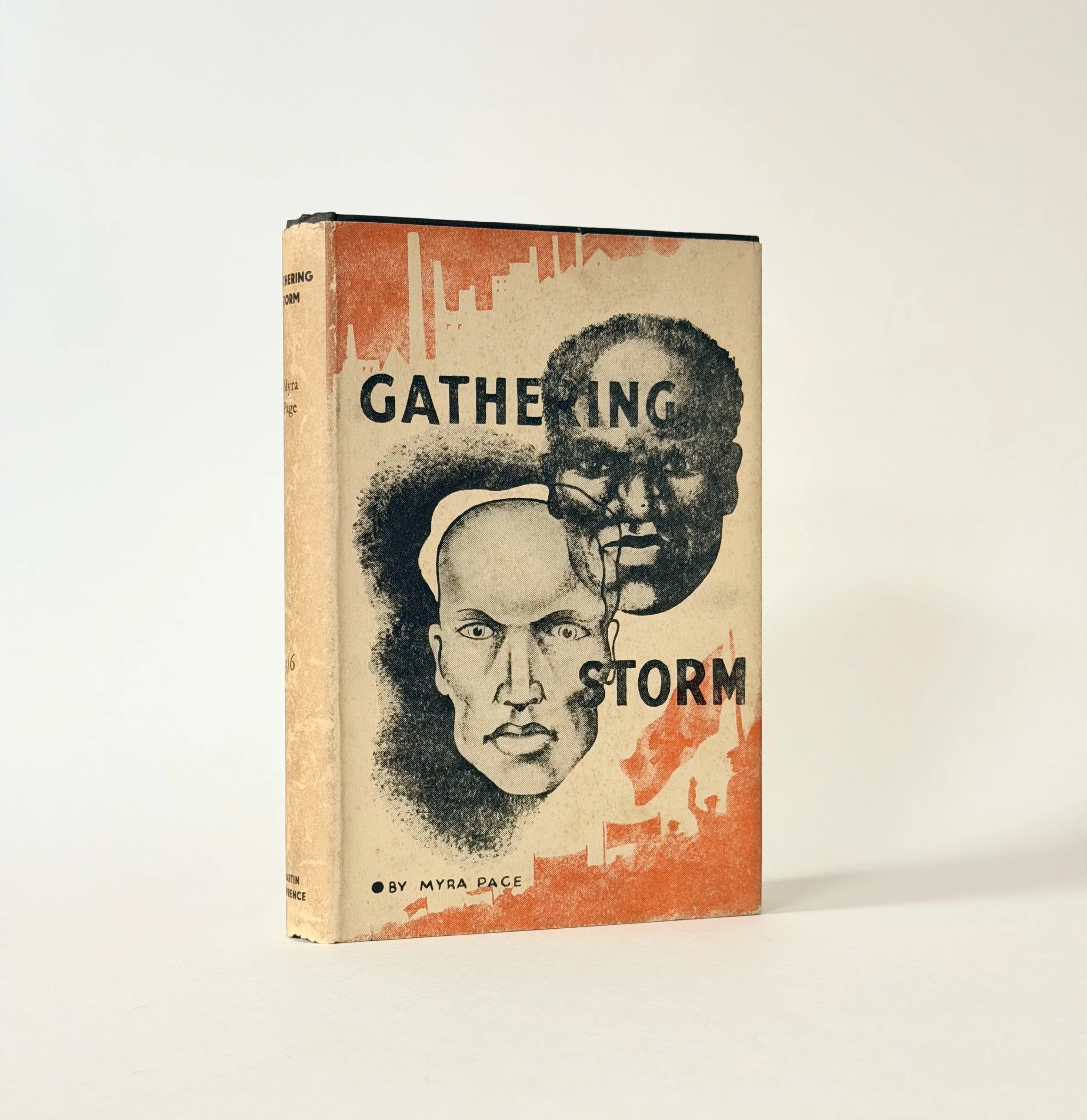
PAGE, Dorothy Myra. Gathering Storm: A Story of the Black Belt. London: Martin Lawrence. 1932. 8vo. First edition. Illustrated by Juanita Preval. Publisher’s black cloth lettered in red to the spine, in the striking dust jacket designed by ‘Paul’. A very good or better copy. The boards clean, the corners and tips gently pushed. The binding tight and square. The textblock edges gently marked, the contents clean throughout. The dust jacket priced 3/6 net to the spine and front panel, gently rubbed to corners and spine tips, but a very pleasing copy overall.
‘Daughter of the South and worker for change’ Dorothy Markey’s second novel and perhaps her most important, published under her Myra Page pseudonym, so used probably to ensure Markey could continue her teaching roles unaffected. Hailing from Virginia, Markey was exposed to both extreme poverty and racial injustice from childhood, and her vehicle for change quickly turned towards the Communist Party of the USA. After working in various sweatshops and factories in her youth years, Markey had become politically active while gaining a PhD in Anthropology. In the spring of 1929, hundreds of mill workers in Gastonia, North Carolina began a strike against 60-hour work weeks and dire living conditions. Page covered the event in various articles for the Labor Age and Labor Defender. While the following decade saw her publish a plethora of related journalistic pieces, the events of the Loray Mill Strike encouraged this triple-pointed novel, a proletarian novel, a novel which depicts the racial injustice in America, and a novel with strong feminist credentials, depicting working women, their pay gap, squalid living conditions, and sexual violence. Markey would go on to work full-time for the Party and became involved with Soviet espionage before and during the Second World War, writing a novel and various articles on Stalin’s Five Year Plans among other projects. She gradually became disillusioned with the bureaucracy of the organisation and left it in the 1950s, though she continued to write mostly non-fiction advocating for better worker rights, improved living conditions for black Americans, and equality for women, living well into her nineties. The University of North Carolina Press republished the novel for the first time in 2025. Scarce.
PAGE, Dorothy Myra. Gathering Storm: A Story of the Black Belt. London: Martin Lawrence. 1932. 8vo. First edition. Illustrated by Juanita Preval. Publisher’s black cloth lettered in red to the spine, in the striking dust jacket designed by ‘Paul’. A very good or better copy. The boards clean, the corners and tips gently pushed. The binding tight and square. The textblock edges gently marked, the contents clean throughout. The dust jacket priced 3/6 net to the spine and front panel, gently rubbed to corners and spine tips, but a very pleasing copy overall.
‘Daughter of the South and worker for change’ Dorothy Markey’s second novel and perhaps her most important, published under her Myra Page pseudonym, so used probably to ensure Markey could continue her teaching roles unaffected. Hailing from Virginia, Markey was exposed to both extreme poverty and racial injustice from childhood, and her vehicle for change quickly turned towards the Communist Party of the USA. After working in various sweatshops and factories in her youth years, Markey had become politically active while gaining a PhD in Anthropology. In the spring of 1929, hundreds of mill workers in Gastonia, North Carolina began a strike against 60-hour work weeks and dire living conditions. Page covered the event in various articles for the Labor Age and Labor Defender. While the following decade saw her publish a plethora of related journalistic pieces, the events of the Loray Mill Strike encouraged this triple-pointed novel, a proletarian novel, a novel which depicts the racial injustice in America, and a novel with strong feminist credentials, depicting working women, their pay gap, squalid living conditions, and sexual violence. Markey would go on to work full-time for the Party and became involved with Soviet espionage before and during the Second World War, writing a novel and various articles on Stalin’s Five Year Plans among other projects. She gradually became disillusioned with the bureaucracy of the organisation and left it in the 1950s, though she continued to write mostly non-fiction advocating for better worker rights, improved living conditions for black Americans, and equality for women, living well into her nineties. The University of North Carolina Press republished the novel for the first time in 2025. Scarce.