
 Image 1 of 3
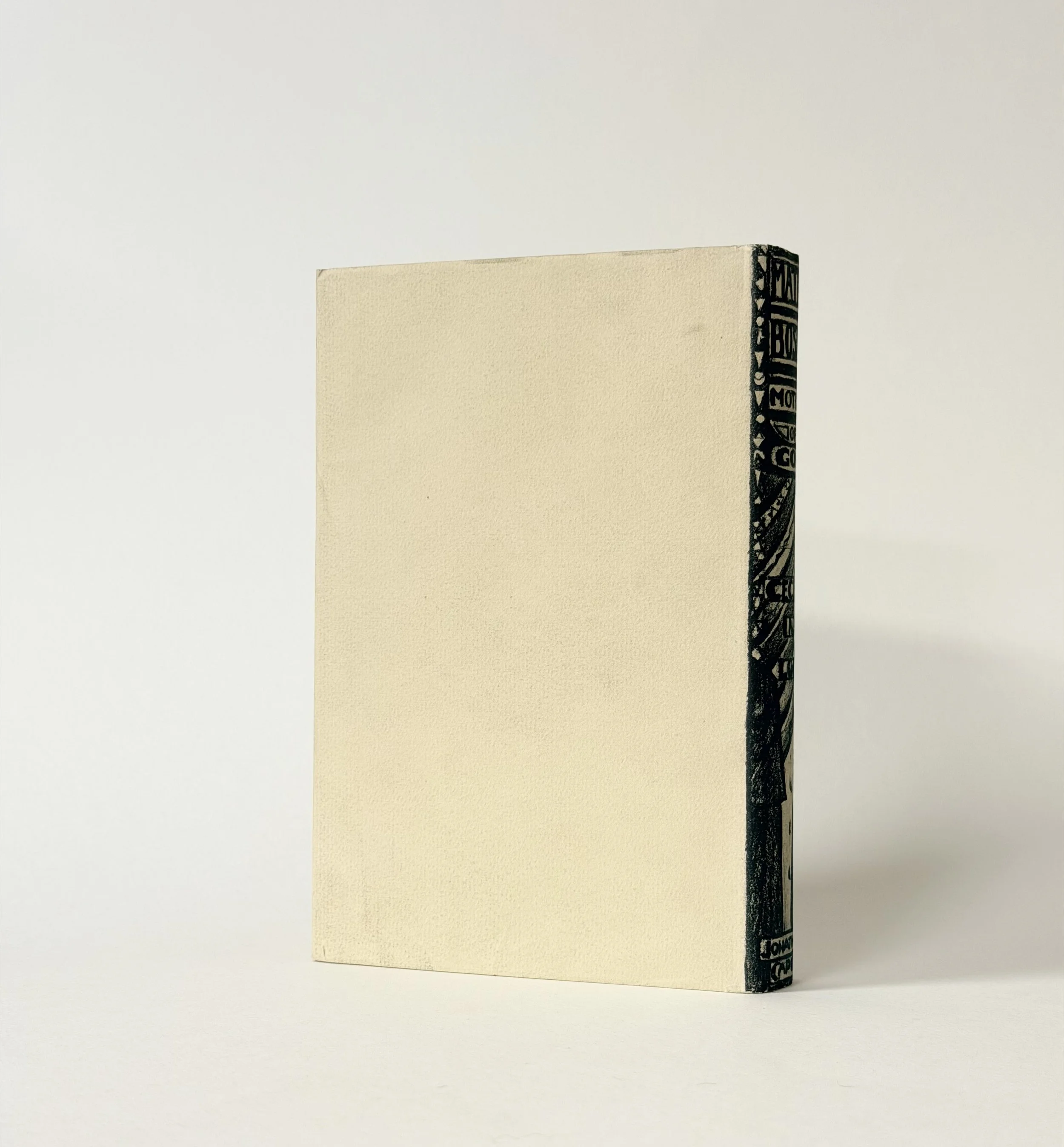 Image 2 of 3
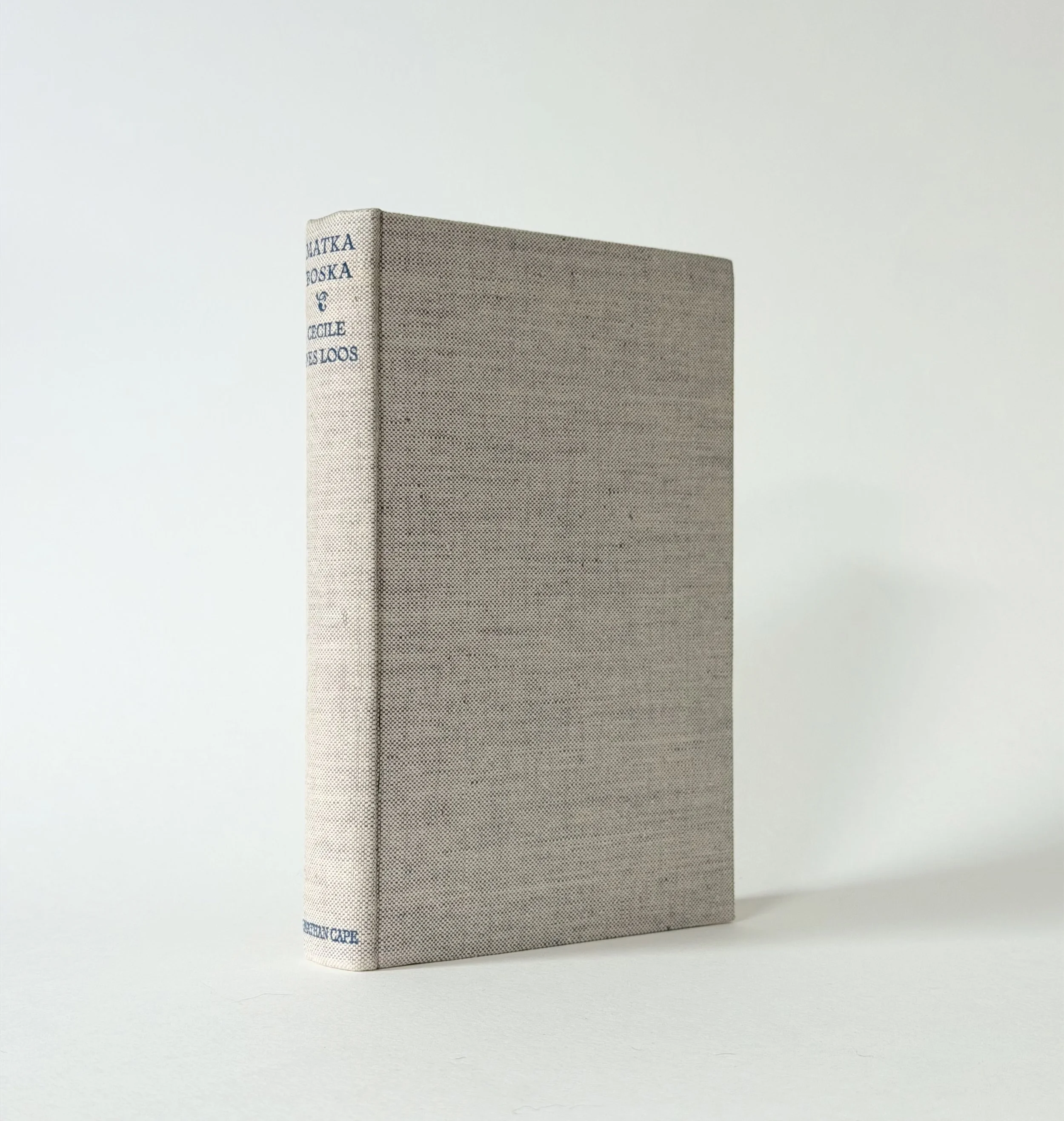 Image 3 of 3
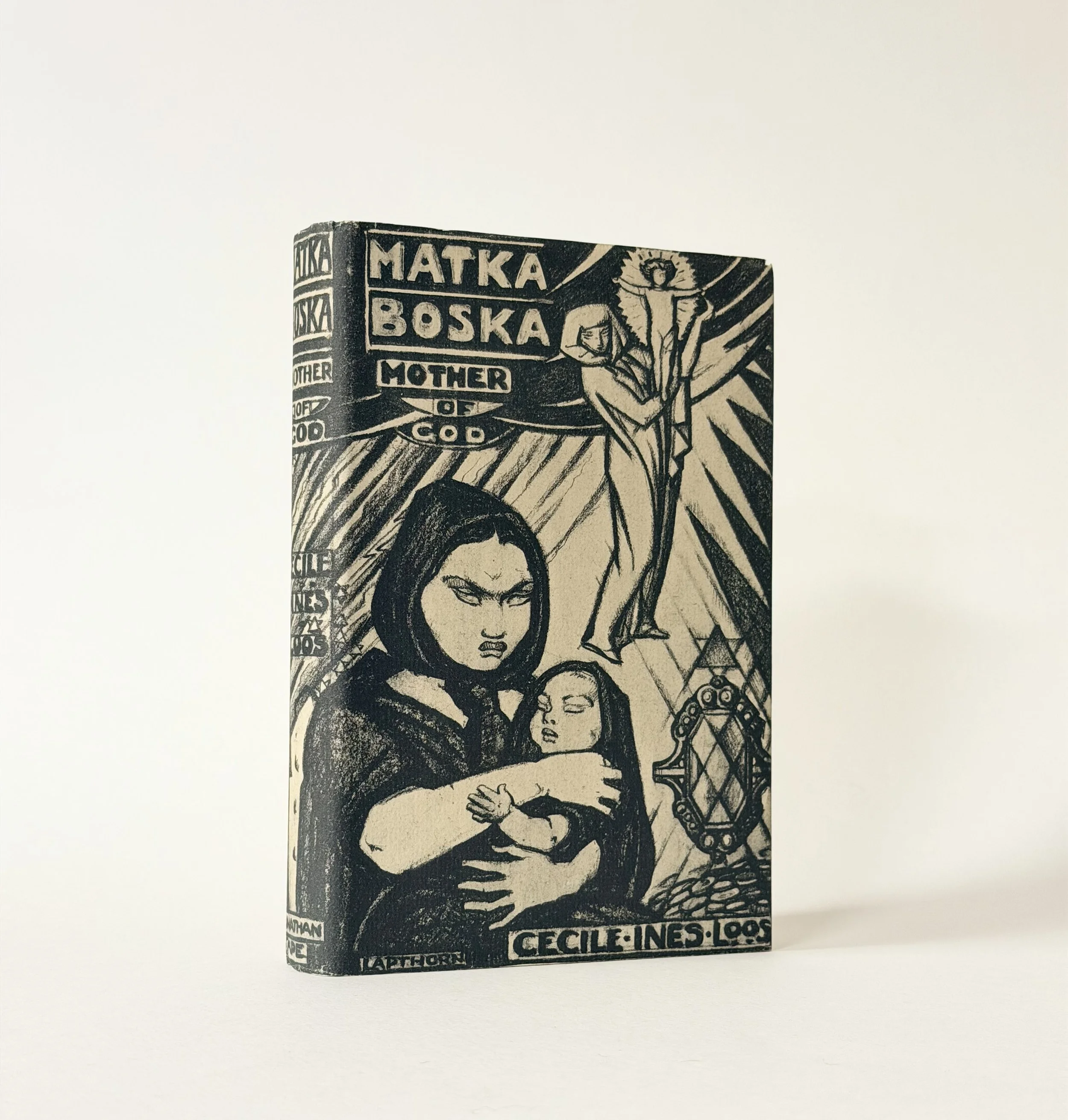
LOOS, Cecile Ines. Matka Boska, Mother of God. Trans. from the German by Margaret Goldsmith. London: Jonathan Cape. 1930. 8vo. First English language edition. Publisher’s cream speckled cloth lettered in dark blue to the spine, in the fabulously macabre dust jacket designed by Mabel Dickinson Lapthorn. With two publisher’s advertising slips loosely inserted. A fine copy, the cloth clean and bright with trivial bump to spine centre. The contents fine but for a little offsetting to front endpaper. The dust jacket unclipped (7s 6d net) and complete, a trifle bumped at corners.
The Swiss author’s strikingly imaginative first novel which follows a young illiterate Polish peasant girl and her daughter, the girl’s self-realisation of the 'philosophy of the oppressed’ in light of her crushing employers who own the Estate. Curiously modernist and often macabre, Loos switches tense with a confident consistency, themes and sentences are repeated time and again, and fantastical worlds within worlds are constructed, with angels, Satan and God all making appearances. A paean to motherhood, the novel is considerably autobiographical. Loos was born in Basel to middle-class parents, but was orphaned by the age of four after both parents died. She left the orphanage trained as a kindergarten teacher, working in Ireland, England, and in Paris before disappearing from records, appearing quite suddenly amid the birth of her illegitimate son, born in Milan. Herein seemed a catalyst for a decade towards insanity. She was unable to take care of the child and entered him into an orphanage. Embittered by the system and seeking a convergence of Communist and Catholic ideals, she spent much of the 1910s in poverty, renting out her two bedrooms while she slept in the corridor. She received psychiatric care but to little avail. She returned to Basel in 1921 and found some solace in a simpler life led by religion while working as a chambermaid. When Matka Boska was published in Germany in 1927, she became a household name overnight. Margaret Goldsmith in her translator’s note considers the novel ‘like a brilliant German translation from the Polish’, the syntax seeming to strike a chord in the German-speaking world. More novels followed—each in similar vein, semi-autobiographical, imaginative, and macabre. “I realise”, she wrote to her friend, Elli Muschg, “that one cannot simply rest on a feather”. Yet gradually, her readership waned and once again she found herself on the breadline or below it, relying on friends to make ends meet. This remains one of her most imaginative and politically-fused novels, and her only work to appear in English. A German-language reissue appeared in 2015, but an English-language reissue and indeed translations of her other novels may someday come. Of additional interest is the exceptional dust jacket designed inimitably by the artist Mabel Dickinson Lapthorn, a London-based artist working in poster design, ceramics, and, occasionally as in here, dust jackets. Scarce.
LOOS, Cecile Ines. Matka Boska, Mother of God. Trans. from the German by Margaret Goldsmith. London: Jonathan Cape. 1930. 8vo. First English language edition. Publisher’s cream speckled cloth lettered in dark blue to the spine, in the fabulously macabre dust jacket designed by Mabel Dickinson Lapthorn. With two publisher’s advertising slips loosely inserted. A fine copy, the cloth clean and bright with trivial bump to spine centre. The contents fine but for a little offsetting to front endpaper. The dust jacket unclipped (7s 6d net) and complete, a trifle bumped at corners.
The Swiss author’s strikingly imaginative first novel which follows a young illiterate Polish peasant girl and her daughter, the girl’s self-realisation of the 'philosophy of the oppressed’ in light of her crushing employers who own the Estate. Curiously modernist and often macabre, Loos switches tense with a confident consistency, themes and sentences are repeated time and again, and fantastical worlds within worlds are constructed, with angels, Satan and God all making appearances. A paean to motherhood, the novel is considerably autobiographical. Loos was born in Basel to middle-class parents, but was orphaned by the age of four after both parents died. She left the orphanage trained as a kindergarten teacher, working in Ireland, England, and in Paris before disappearing from records, appearing quite suddenly amid the birth of her illegitimate son, born in Milan. Herein seemed a catalyst for a decade towards insanity. She was unable to take care of the child and entered him into an orphanage. Embittered by the system and seeking a convergence of Communist and Catholic ideals, she spent much of the 1910s in poverty, renting out her two bedrooms while she slept in the corridor. She received psychiatric care but to little avail. She returned to Basel in 1921 and found some solace in a simpler life led by religion while working as a chambermaid. When Matka Boska was published in Germany in 1927, she became a household name overnight. Margaret Goldsmith in her translator’s note considers the novel ‘like a brilliant German translation from the Polish’, the syntax seeming to strike a chord in the German-speaking world. More novels followed—each in similar vein, semi-autobiographical, imaginative, and macabre. “I realise”, she wrote to her friend, Elli Muschg, “that one cannot simply rest on a feather”. Yet gradually, her readership waned and once again she found herself on the breadline or below it, relying on friends to make ends meet. This remains one of her most imaginative and politically-fused novels, and her only work to appear in English. A German-language reissue appeared in 2015, but an English-language reissue and indeed translations of her other novels may someday come. Of additional interest is the exceptional dust jacket designed inimitably by the artist Mabel Dickinson Lapthorn, a London-based artist working in poster design, ceramics, and, occasionally as in here, dust jackets. Scarce.