
 Image 1 of 3
 Image 2 of 3
 Image 3 of 3
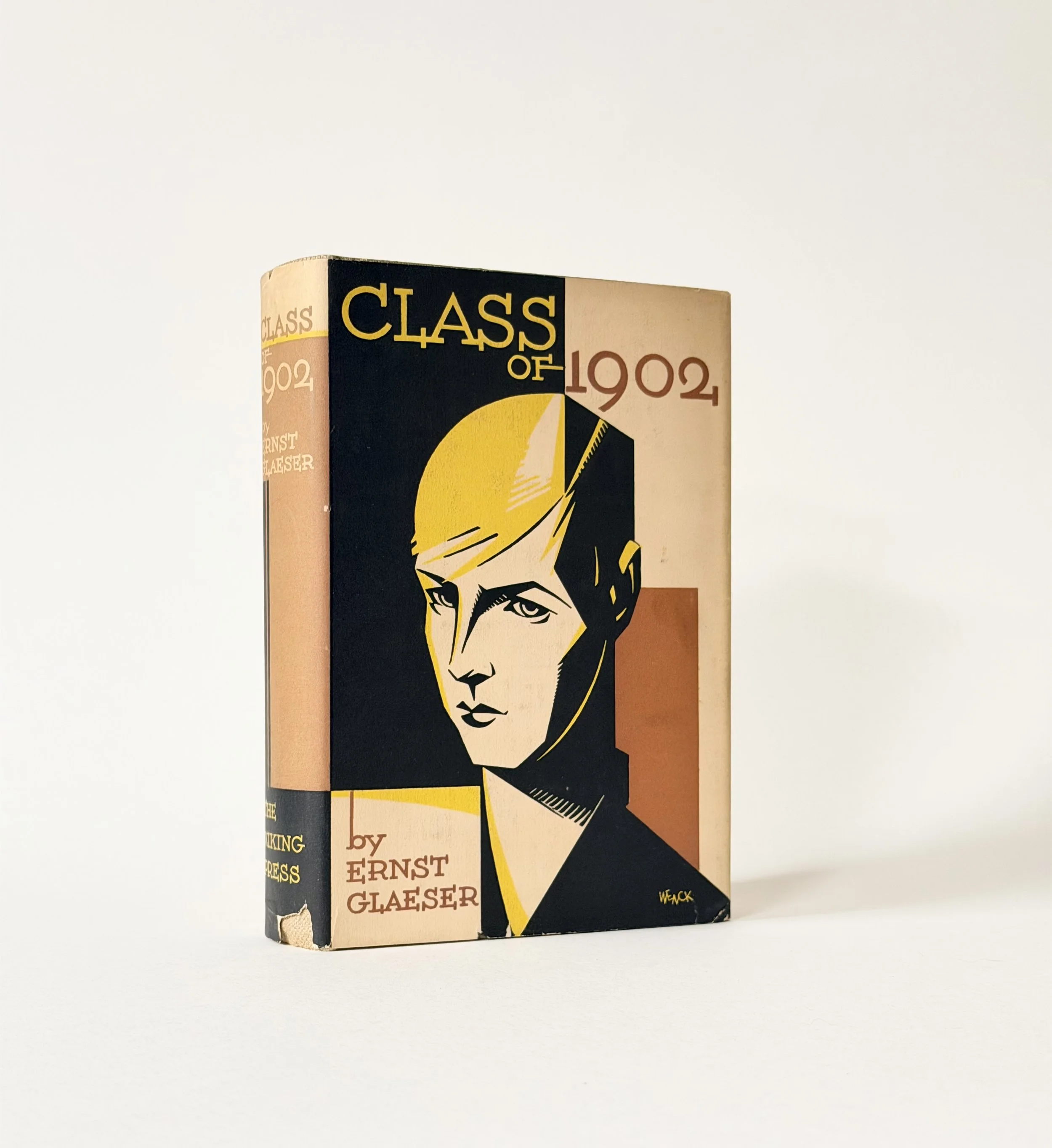
GLAESER, Ernst. Class of 1902. Trans. from the German by Willa and Edwin Muir. New York: The Viking Press. 1929. 8vo. First American edition. Publisher’s grey buckram lettered in brown to the spine and upper board, in the marvellous dust jacket designed by Paul Wenck. A very good copy overall, the cloth clean and bright, the binding tight and square, the topstain bright. The contents mostly fine throughout, ink previous owner signature to front endpaper, a few light marks, else sharp. The dust jacket unclipped ($2.50) 1cm chip to the spine foot, two other small nicks, a few small closed tears, the spine panel slightly faded, but a bright and pleasing example overall.
The author’s most famous work, an international hit translated across the world. ‘The Class of 1902’ was the term used for those German soldiers born in that year, called to action in the closing stages of the First World War. These soldiers, Glaeser one of them, children at the outbreak of war, underwent an experience seldom endured by any other generation; coming of age during the horrors of international war. Mighty praise adorns the front flap, from Thomas Mann and Erich Maria Remarque. Glaeser fled Germany amid the rise of the Nazis—his books, like many exiled authors, were burned, yet much like his contemporary, Hans Fallada, Glaeser vowed to return to his beloved country, initially, seemingly, out of pure devotion to the country and its people, though later, confusingly, he swore allegiance to the Third Reich, agreeing to publish a trilogy of works glorifying the Reich, which never came to fruition. His fellow exiles denounced him as a traitor and, again like Fallada up until recently, he was unable to restore his earlier reputation.
GLAESER, Ernst. Class of 1902. Trans. from the German by Willa and Edwin Muir. New York: The Viking Press. 1929. 8vo. First American edition. Publisher’s grey buckram lettered in brown to the spine and upper board, in the marvellous dust jacket designed by Paul Wenck. A very good copy overall, the cloth clean and bright, the binding tight and square, the topstain bright. The contents mostly fine throughout, ink previous owner signature to front endpaper, a few light marks, else sharp. The dust jacket unclipped ($2.50) 1cm chip to the spine foot, two other small nicks, a few small closed tears, the spine panel slightly faded, but a bright and pleasing example overall.
The author’s most famous work, an international hit translated across the world. ‘The Class of 1902’ was the term used for those German soldiers born in that year, called to action in the closing stages of the First World War. These soldiers, Glaeser one of them, children at the outbreak of war, underwent an experience seldom endured by any other generation; coming of age during the horrors of international war. Mighty praise adorns the front flap, from Thomas Mann and Erich Maria Remarque. Glaeser fled Germany amid the rise of the Nazis—his books, like many exiled authors, were burned, yet much like his contemporary, Hans Fallada, Glaeser vowed to return to his beloved country, initially, seemingly, out of pure devotion to the country and its people, though later, confusingly, he swore allegiance to the Third Reich, agreeing to publish a trilogy of works glorifying the Reich, which never came to fruition. His fellow exiles denounced him as a traitor and, again like Fallada up until recently, he was unable to restore his earlier reputation.